
Pittsylvania County Court Records After a Jail Arrest
After a Pittsylvania County arrest, there are two tracks to follow. The first is custody: whether the person is at Pittsylvania County Jail, in a Blue Ridge Regional Jail Authority facility because of overflow, already released, or later moved into state custody. The second is the court record: the public case information that shows the charges filed in General District Court or Circuit Court, the next hearing, the result of each charge, and any later disposition.
The local court and jail systems are close together in Chatham, but they do not publish the same information. The jail inmate records side helps confirm current custody, booking timing, bond, and possible transfer. The jail roster mugshots side explains booking photos and public-records requests. Court records after an arrest are different because they follow what prosecutors and judges do with the charges, not simply what appeared on intake paperwork.
The county's General District Court handles misdemeanors, traffic matters, arraignments, and preliminary hearings for felony cases. The Commonwealth's Attorney for Pittsylvania County, Robert "Bryan" Haskins, prosecutes criminal violations of the Code of Virginia. That prosecutor review is one reason a jail booking charge can later look different in court records. A charge may be reduced, amended, certified to Circuit Court, indicted, dismissed, or marked nolle prosequi as the case moves forward.
How to Find Court Records After an Arrest in Pittsylvania County
For public online case information, start with the Virginia court systems rather than a jail page. The Pittsylvania County General District Court page states that case information is available online by docket number or name through the Virginia Courts website. General District Court matters include misdemeanors, traffic cases, arraignments, and preliminary felony hearings. If a felony is certified or indicted, the Circuit Court side may become necessary for later filings and disposition history.
The county's General District Court page explains the court's criminal role and online case-search route.
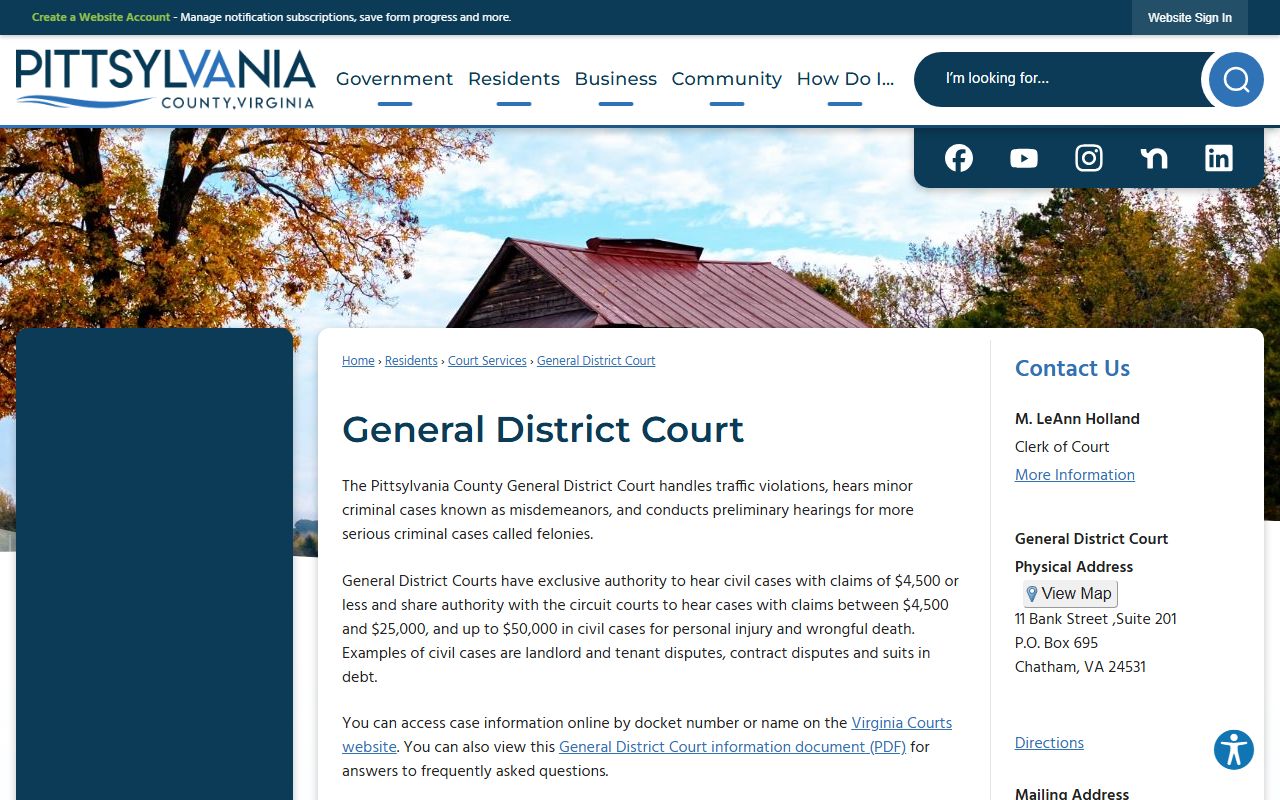
Use that court source for charge and hearing information, then use jail or VINE channels separately for custody location and release questions.
- Open the Virginia Courts case information system and choose the Pittsylvania court or locality when the search form requires a court selection.
- Search by the defendant's name first if no case number is available. Use the spelling that appears on the summons, warrant, jail paperwork, or attorney notice.
- Search by case number if the jail, court, warrant, summons, or attorney has supplied one.
- Open each matching criminal or traffic case and review the charge list, code section, hearing date, court, and current status.
- For felony matters, check whether a General District Court preliminary hearing was certified to Circuit Court or whether a grand jury indictment opened a Circuit Court case.
Virginia's statewide Online Case Information System can also help when the reader is unsure which court has the case. It is still a court-record tool, not a live jail roster. When the immediate question is "where is this person now," call Pittsylvania County Jail Administration, use Virginia VINE, or check the relevant Blue Ridge Regional Jail Authority JailTracker route if the person was transferred out of the county jail.
Court Search Fields for Records After a Pittsylvania Arrest
The General District Court online help identifies the core fields used to locate a case. These fields matter because an arrest may create several public references: a booking event, a warrant number, a court case number, and later a Circuit Court case if the felony path continues.
| Field Label | Type | Required | How to Use It |
|---|---|---|---|
| Court | Dropdown | Yes | Select the Pittsylvania court or locality. The system searches one court at a time. |
| Search by Name | Search mode | Conditional | Use when the defendant name is known but the case number is not. |
| Last Name | Text | Yes for name search | Enter the defendant's last name as it appears on court or arrest paperwork. |
| First Name | Text | No | Add the first name to narrow common-name results. |
| Middle Name or Initial | Text | No | Useful when multiple defendants have similar names. |
| Suffix | Text | No | Use Jr., Sr., III, or another suffix only if it appears in the court record. |
| Case Number | Text | Conditional | Best when a warrant, summons, clerk notice, or attorney letter gives the exact case number. |
| Hearing Date | Date | Conditional | Use when checking a scheduled arraignment, review, preliminary hearing, or trial date. |
| Data Status | Dropdown | No | Choose Current, Archived, or All when the form offers that option. |
Charging Documents in Court Records After an Arrest
A jail arrest starts with custody, but a criminal case moves through charging paperwork. In Virginia local practice, the document may be connected to a warrant, summons, criminal complaint, preliminary hearing, or later grand jury action. The exact document controls which court hears the matter, what the accused is alleged to have done, and whether the charge is treated as a misdemeanor or felony.
| Charging Document | Who Uses or Issues It | Common Role After Arrest | Where It May Lead |
|---|---|---|---|
| Criminal complaint or warrant paperwork | Law enforcement, magistrate, or prosecutor process | Documents the alleged offense and supports arrest or court process. | General District Court arraignment, bond review, or misdemeanor case track. |
| Summons | Officer or court process | Orders the defendant to appear without necessarily creating the same custody path as a jail booking. | General District Court hearing date and public case entry. |
| Information or prosecutor filing | Commonwealth's Attorney | Reflects prosecutor review and may refine the filed charge from the booking label. | Misdemeanor prosecution or felony procedural step depending on the case. |
| Indictment | Grand jury | Creates or advances a felony accusation in Circuit Court. | Circuit Court arraignment, trial, plea, sentencing, or dismissal. |
The prosecutor's page is important for this distinction. Pittsylvania's Commonwealth's Attorney prosecutes Code of Virginia violations and works with the Sheriff's Office, Victim Witness Assistance Program, and other law-enforcement agencies. A felony is described by the office as a serious crime punishable by the possibility of more than one year in prison. A misdemeanor is less serious and cannot carry punishment greater than one year in jail.
Charge Status in Court Records After a Jail Arrest
Charge status is the part of the record most likely to change after booking. A jail record may show the arresting charge at intake. The court record may later show a prosecutor-filed charge, an amended code section, a reduced level, a dismissal, a nolle prosequi entry, certification to Circuit Court, indictment, conviction, or acquittal. Read every charge row separately because one case can contain several charges with different outcomes.
| Status | What It Means | Why It Matters |
|---|---|---|
| Pending | The charge remains active and has not reached a final disposition. | Check the next hearing date and court location before assuming the case is resolved. |
| Amended | The charge language, code section, or case details changed. | The final court charge may not match the booking charge listed after arrest. |
| Reduced | The charge was lowered to a less serious offense. | This may affect punishment range, court path, and later background-check interpretation. |
| Dismissed | The court ended the charge without a conviction. | A dismissal is not the same as automatic expungement from public records. |
| Nolle prosequi | The prosecutor chose not to proceed on that charge. | The charge did not continue, but record-clearing requires separate legal analysis. |
| Certified | A felony preliminary-hearing matter moved toward Circuit Court. | Search Circuit Court records for the next phase. |
| Indicted | A grand jury accusation was filed in Circuit Court. | The Circuit Court case may carry the main felony record going forward. |
| Convicted or acquitted | The case ended with guilt established or a not-guilty result. | Do not treat either result as interchangeable with the original arrest record. |
Bond, Release, and Court Records After an Arrest
Bond information often sits at the crossing point between jail custody and court records. Local research did not locate a Pittsylvania-specific bond payment desk, accepted payment list, or bond-posting hours on the county jail pages. The safe local workflow is to confirm custody first, then confirm who set bond and what payment instructions apply before traveling. Jail Administration can address current custody at 434-432-7831, while the magistrate, General District Court, Circuit Court, or an attorney may be needed for bond authority and conditions.
| Bond Type | How It Works | Pittsylvania Note |
|---|---|---|
| Personal recognizance or unsecured bond | Release based on a promise to appear, sometimes without paying the full amount up front. | The court or magistrate controls the conditions. |
| Cash bond | Money is deposited to secure appearance. | County pages reviewed did not publish payment methods or payment location. |
| Surety bond | A licensed bondsman or surety posts bond for a fee or collateral. | Confirm the court and jail requirements before using a bondsman. |
| Secured bond | Release requires money, property, or surety security. | Amount and type may appear in public court or jail records when available. |
| No-bond hold | The person cannot be released until a court or agency changes the hold. | Can involve serious charges, probation or parole holds, another jurisdiction, federal/ICE detainers, or court orders. |
Warrants That Create Court Records After an Arrest
An outstanding warrant can be the event that leads to a Pittsylvania booking and court record. The Sheriff's site navigation includes "Wanted Persons," and the Sheriff's services page lists CrimeStoppers at 800-791-0044, but the research did not capture a fully inspectable official active-warrant search database. Do not rely on a roster alone for warrant status. Call the Sheriff's Office at 434-432-7800, contact General District Court at 434-432-7879 for court-issued process tied to misdemeanor, traffic, or preliminary felony matters, or speak with an attorney before appearing in person.
Warrant-related terms can point to different records. An arrest warrant authorizes taking a person into custody based on an alleged offense. A bench warrant or capias often follows failure to appear or violation of a court order. A search warrant is not the same as an arrest warrant. A fugitive warrant or hold can mean another jurisdiction controls part of the release process even if Pittsylvania is where the person was arrested.
Charges vs. Convictions in Court Records After an Arrest
An arrest and a charge are not proof of guilt. A court record may remain publicly visible while the case is still pending, and the final outcome may differ sharply from the arrest label. That is why court records should be read by status, date, and disposition rather than by the first charge line alone.
| Charge | Conviction | |
|---|---|---|
| Meaning | An accusation filed through law-enforcement, magistrate, court, or prosecutor process. | A finding or plea of guilt accepted by the court. |
| Stage | Can appear soon after arrest and before final hearings. | Appears after plea, trial, or other final court action establishing guilt. |
| Standard | Based on probable cause or charging requirements. | Requires proof beyond a reasonable doubt or a guilty plea. |
| Record Meaning | May later be amended, reduced, dismissed, nolle prossed, certified, or indicted. | May lead to sentencing, appeal, probation, jail, or prison records. |
| Use Caution | Does not mean the person was convicted. | Still should be verified against the originating court record. |
Sealed vs. Expunged Court and Arrest Records
Virginia law provides an expungement procedure for eligible police and court records, including certain mistaken-identity, pardon, vacated-conviction, and qualifying non-conviction situations. A dismissal or nolle prosequi entry does not automatically erase every public trace. The person generally needs a court order or other qualifying legal action before agencies update or restrict records.
| Sealed | Expunged | |
|---|---|---|
| Public Visibility | Hidden or restricted from ordinary public access. | Removed or treated under the expungement order according to Virginia procedure. |
| Record Type | May involve court files, juvenile matters, sensitive filings, or records restricted by law. | May involve eligible police and court records listed under Virginia expungement law. |
| Agency Access | Some official access may remain depending on the order and statute. | Access and handling depend on the expungement order and applicable law. |
| Eligibility | Depends on the record type and court rule or statute. | Depends on Va. Code § 19.2-392.2 and the specific case outcome. |
| Practical Step | Ask the clerk or an attorney how the record is restricted. | Use the court process, then provide the order to agencies as instructed. |
Circuit Court Records After a Felony Arrest
Felony cases may begin in General District Court for preliminary-hearing purposes, then continue in Circuit Court after certification or indictment. The Pittsylvania County Circuit Court public-records page says records can be viewed in person at the Clerk's Office except for sealed records such as certain Juvenile and Domestic Relations appeals. It also lists copies at $0.50 per page and certified copies at $2 per document.
That means an online court search may be enough for status, but the Clerk's Office may be needed for file review or official copies. The Circuit Court Clerk contact listed through Court Services is Angie R. Harris at 434-432-7887. For the General District Court, the research lists 11 Bank Street, Suite 201, P.O. Box 695, Chatham, VA 24531, phone 434-432-7879, fax 434-432-7915, and Clerk M. LeAnn Holland.
Background Checks and Court Records After Arrest
Casual court-record lookup is different from a regulated background check. Public court systems can help a person understand a pending case, hearing date, or disposition, but employment, tenant screening, credit, insurance, and other regulated decisions require proper legal channels and FCRA-compliant consumer-reporting practices.
Important: Pittsylvania County Inmate Population is not a consumer reporting agency under the Fair Credit Reporting Act, and the information here may not be used for FCRA-covered decisions.
Restricted Court Records After an Arrest in Pittsylvania County
Not every record tied to an arrest is open online. Virginia FOIA presumes public records are open unless a specific exemption applies, but law-enforcement and criminal-record disclosure rules can still allow or require withholding certain material. Juvenile matters, sealed records, sensitive victim information, active investigative material, protected personal details, and records restricted by a court order may not appear in the same way as adult public criminal cases.
For records that are not online, use the right office for the record type. Court dispositions and file copies belong with the court clerk. Prosecutor questions about subpoenas or witness attendance go to the Commonwealth's Attorney at 434-432-7900. Custody and booking records begin with the jail, the Sheriff's Office, or the county FOIA/NextRequest process when the record is not otherwise available.